Why Ukraine buys KF41 Infantry Fighting Vehicle and why it matters
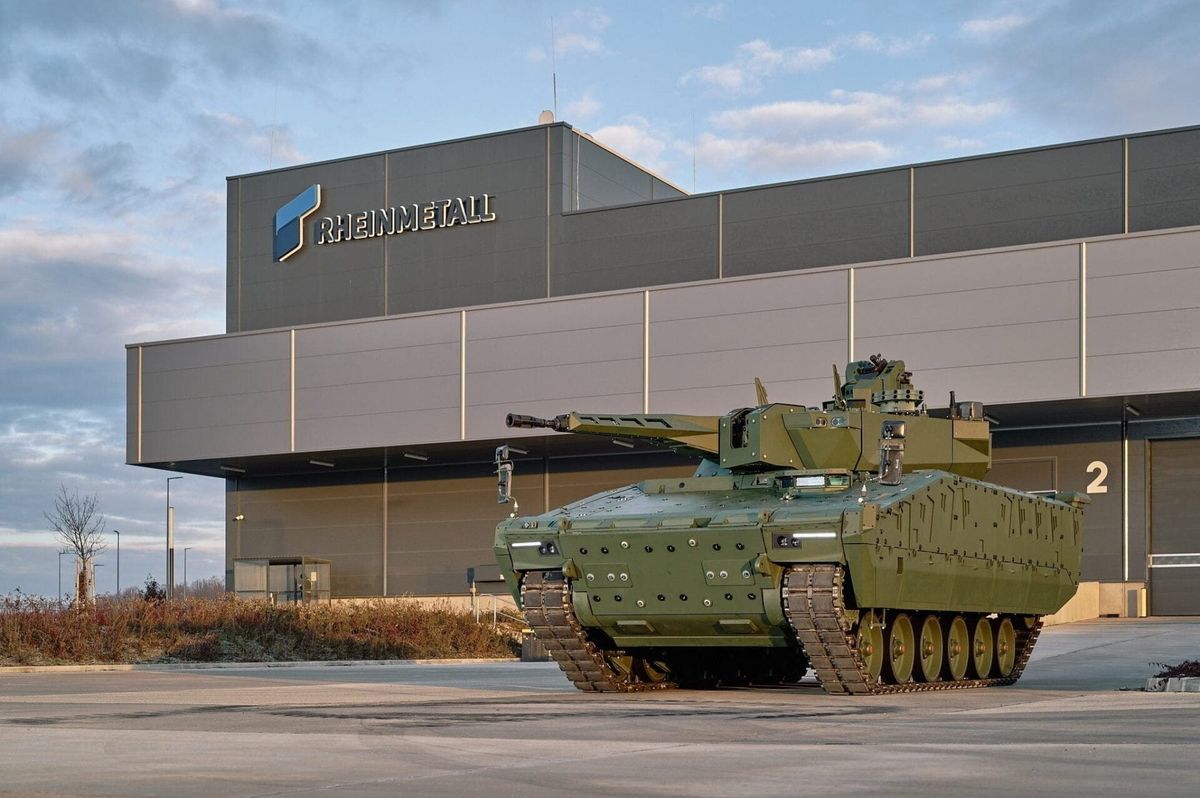
Since Russia's war of aggression against Ukraine and the ensuing intensified debate on armament decisions, particularly with regard to the future of armored forces, I have been writing articles advocating the retention of armored forces and their further development.
Now a development has occurred that only reveals the full significance of the decision at second glance.
Rheinmetall recently announced that it will provide a first batch of KF41 LYNX Infantry Fighting Vehicle (IFV) [1].
What is so important about this decision of the Ukrainian Armed Forces?
KF41 - which stands for Kettenfahrzeug/tracked vehicle - has been tested and selected by one of the most war-experienced armies in the world. Beside this, with the support of the Ukrainian Armed Forces, Rheinmetall will probably collect first hand knowledge of the performance of this IFV. And the whole set of tracked vehicles of Rheinmetall will benefit from these lessons learned through future enhancements.
But why is this so important?
Contrary to the depicted foolishness on 99% of all social media posts, either here on LinkedIn or any other platform, the russian soldiers are not completely brainless orks, dumb mobiks or corrupt mercenaries. The Russian Armed Forces have established structures to adapt and learn. One of these institutions is Rubikon. "Innovation in war is not about conceptual superiority or technological aesthetics. It is about implementation under pressure, adaptability, and feedback from the battlefield. And exactly this is what Russia is doing right now" [2].
"If Europe cannot prove its systems under realistic conditions, Rubikon will. And it will do so on the battlefields of Ukraine, demonstrating, at scale, how vulnerable untested innovation can be. The side that learns faster, iterates harder, and deploys without illusion will define the next phase of warfare" [2].
The Lynx is already acquired by Hungary and Italy also signed a Memorandum of Understanding to procure more than 1.000 KF41 [2]. The will be a joint venture between @Rheinmetall and the Italian defense company @Leonardo. Therefore, also Hungary and Italy as well as the German Federal Armed Forces with their Puma IFV from Rheinmetall and @KNDS will probably benefit from these lessons learned. This is the way innovation has to be executed in times of war.
But what kind of lessons need to be learnt?
There are plenty of lessons to be learnt. Some armoured specific are:
- to launch attack drones and loitering munitions on the move, under armor, and protected by layered counter-unmanned aircraft systems [3].
- to defend against the same. Our entire acquisition model must adapt to product life cycles measured in weeks and days. Armored formations will survive by surrounding themselves with a bodyguard of attritable and consumable systems, upgraded and adapted on a continuous basis to endure in this deadly
economy [3]. Furthermore, active protection systems, jammers (electronic warfare systems) or other counter UAV systems need to be tested in conjunction.
- Surveillance is now pervasive. Formations will survive by looking unimportant. Enemy forces will seek to blend in with civilian infrastructure and populations. Armored formations must adapt by becoming experts at masking signals, thermals, and optical signatures.
The question of production was probably also a deciding factor. The procurement of the Lynx apparently involves a joint industrial project for the manufacture of Lynx vehicles in Ukraine. Rheinmetall will open the factory in Ukraine before the end of this year [4]. Also this decision might benefit the adaptability of the Lynx. Necessary changes can be done locally and if they proof successfully, they can be integrated into serial production. And furthermore, Rheinmetall will learn how to learn and adapt as an organisation and particularly will learn how to build an adaptable tank production under wartime conditions.
With these measures Rheinmetall is strengthening the KF41, the KF51 Panther main battle tank, all future developments of armored vehicles, its production capabilities, and its stance as all domain defense company. This is not only crucial for Rheinmetall, but as the main land warfare supplier in Europe, this will have consequences for the effectiveness of future combat systems of European land forces.
[1] Press release - Rheinmetall to supply Ukraine with first batch of Lynx KF41 IFVs:
https://www.rheinmetall.com/en/media/news-watch/news/2026/01/2026-01-12-rheinmetall-supplies-lynx-to-ukraine
[2] What We Get Wrong About Russia’s Drone Revolution – And Why This Might Cost Us Everything:
https://new-defense.com/what-we-get-wrong-about-russias-drone-revolution-and-why-this-might-cost-us-everything/
[3] The Coming Blitzkrieg - Adapting Armored Formations for the Future of Warfare:
https://www.armyupress.army.mil/Journals/Military-Review/Online-Exclusive/2025-OLE/The-Coming-Blitzkrieg/
[4] CPM - Ukraine entscheidet sich für den Lynx von Rheinmetall:
https://defence-network.com/ukraine-entscheidet-fuer-lynx-von-rheinmetall/