Maduro's capture - the new business as usual
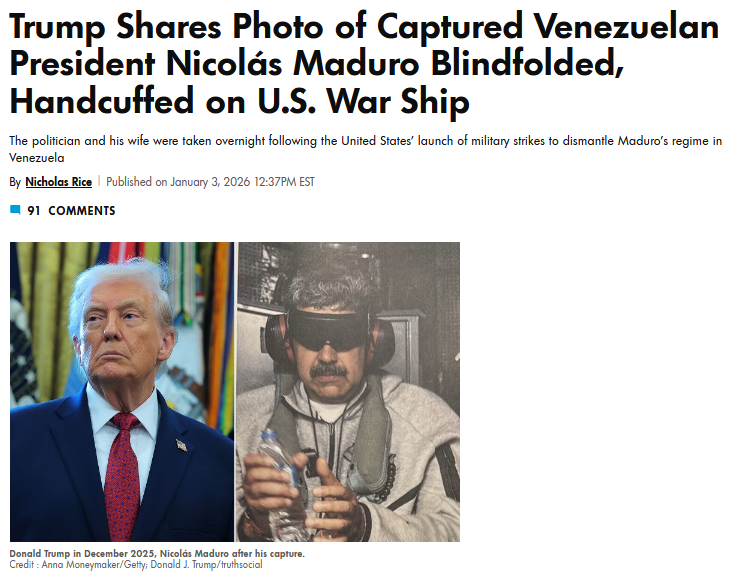
Another contribution on the abduction of President Maduro? I wish it weren’t necessary. But unfortunately, I have read so much about it that amounted to monocausal nonsense, or analyses that were good in themselves but usually focused only on isolated aspects.
This morning, President Trump announced that Venezuelan President Maduro would be arrested by U.S. special forces as part of a military operation in Caracas, the capital of Venezuela, and flown out together with his wife in order to later put him on trial [1].
As far as the justification of this measure under international law is concerned, I am not aware of any, nor have I read anything meaningful that would justify this kind of approach.
That the 2024 elections were, in all likelihood, rigged and clearly did not meet international standards was obvious [2]. Many governments did not recognize the election and thus the current Venezuelan government under Maduro. However, I am not aware of any case in which this would justify a military operation—especially since the current action is unsuitable to remedy this deficit, as the regime is still in power. Moreover, the idea that the United States intends, at least for the time being, to run Venezuela’s government affairs is hardly democratic. And what happens if the next elections once again produce a government that is undesirable from a U.S. perspective?
In connection with the 2024 elections, human rights violations were repeatedly mentioned as well [3]. But these, too, do not justify such measures. If one wanted to invoke the Responsibility to Protect (R2P), interventions would have had to take place promptly and decisively in order to protect the Venezuelan population in a timely manner [4]. Yet the regime remains in power.
The argument of combating drug trafficking and the associated national security interest also falls short. After all, “China was the dominant source of fentanyl coming into the United States, but the flow has significantly decreased since authorities banned production of all fentanyl variants in 2019. However, China is still the leading manufacturer of fentanyl ingredients, known as precursor chemicals. Most of the fentanyl smuggled into the United States from Mexico is made from chemicals from China” [5]. Therefore, China and Mexico should have been the target of Trump’s anger.
To what extent regime change is the goal remains to be clarified, since for now Maduro’s government is still in power through Vice President Rodríguez. Reuters quotes: “One source close to the opposition, who asked not to be named, said Maduro’s removal was an ‘inside job’ aided by Venezuela’s military. ‘For now no more military action, but this was a message to the rest of the members of Venezuela’s government—look what the United States is capable of, get out now and negotiate,’ the source said, without offering evidence” [6].
President Trump said there would be a group of loyal individuals who would govern the country on behalf of the United States. How this is supposed to be implemented remains to be seen. Venezuela is to get back “on track.” The coming days will show what that actually means. At the press conference, Trump said that the vice president had spoken with Secretary of State Rubio and that she was willing to cooperate.
What currently puzzles me greatly about this statement is the fact that Maduro must have had loyal followers; otherwise, the regime would have collapsed much earlier. Where are these loyalists now? And will they simply accept the transfer of power? Unfortunately, I am far too unfamiliar with the internal Venezuelan power dynamics to answer this. It remains exciting.
So what is really behind all this?
In an interview on January 3, 2026, Trump stated very clearly that oil companies would pay for the restoration of production capacities themselves, even if this were to cost billions. The fact that the oil industry was such a prominent topic at the press conference immediately following Maduro’s arrest reveals the real focus [7].
Personally, regarding the timing, I believe this is also connected to the release of the Epstein files. Trump wants to distract from domestic political issues, as well as from his weak polling numbers. Midterm elections are taking place this year, and the Trump administration needs to score points. A “won” conflict and the prospect of flowing petro-dollars can certainly help.
Of course, the influence of Russia and China on the Maduro regime also plays a role. In a potential future confrontation with China, Washington cannot afford to tolerate a regime loyal to China on the other side of the Gulf of Mexico.
What does this mean now?
Predictions are difficult at this point. The main question is whether this half-baked regime change will actually materialize and whether the Venezuelan population will truly benefit from it. Looking at the track record of U.S. interventions since the Korean War, the balance sheet is extremely meager—one could even say catastrophic.
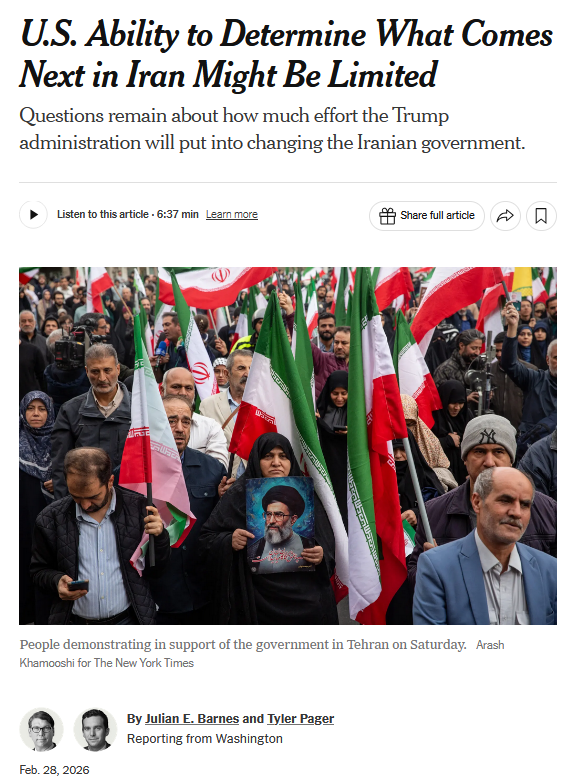
If the abduction of Maduro proves successful, one must assume that the Trump administration will continue to use such methods. In the context of the current protests in Iran, Trump has already warned the mullah regime. In a brief post on social media, he wrote: “We are locked and loaded and ready to go,” but gave no further details [8].
However, I can well imagine that neither China nor Russia has any serious interest in a U.S. success in Venezuela. The question now is what they will make of this, or how they might intervene without being directly linked to it.
Some commentators have also interpreted Maduro’s abduction as a warning to other South American heads of state and government—aka Monroe Doctrine 3.0 [9]. To me, that seems more like a threat. The problem with threats is that they destroy trust and loyalty. This will make it easier for China and Russia to gain influence in some South American countries. Whether the United States will succeed in pushing back this influence everywhere seems doubtful to me.
From my perspective, little has changed since Trump’s re-election. He is acting faster and more decisively than during his first term. He is doing what was announced in the recently published National Security Strategy.
This event is definitely not a return of power politics. That has been back in Europe at least since 2014. With the election of Xi Jinping, it has returned to the global stage. And Trump brings his own, distinctive note into this game. It shows that the current U.S. administration is also prepared to dismantle the global order created after World War II. This pleases Xi and Putin and will play into their hands.
Europe is currently experiencing how the United States is shifting its priorities. Anyone who believes that Washington can simultaneously stabilize Ukraine, the Middle East, the Sahel, the Indo-Pacific—and now Venezuela as well—is mistaken [10].
What I find hypocritical about the debate in Germany and Europe is the fact that since reunification, or since the collapse of the Soviet Union, we have outsourced power politics and power-political thinking entirely to the United States, have not been honest with ourselves about power dynamics, and have hidden from reality for far too long. If former or current politicians now lament this situation, they should ask themselves what they did to prevent it from happening. Most will then have to look away in shame. Anyone who, in the fourth year of war, fails to muster the courage and political determination to defend a European neighbor in its struggle for survival against a fascistoid, imperial dictator should humbly remain silent in the face of current developments—because the fact that all this is possible is also due to our collective cowardice and complacency.
One of my favourite journalists wrote:
"Venezuela, my quick take:
Does Venezuela deserve a new start without its kleptocratic dictator, Maduro? Absolutely.
Should we applaud when Putin and Xi are losing an ideological and practical ally? Definitely.
Does this justify a brutal violation of state sovereignty by the US? No."
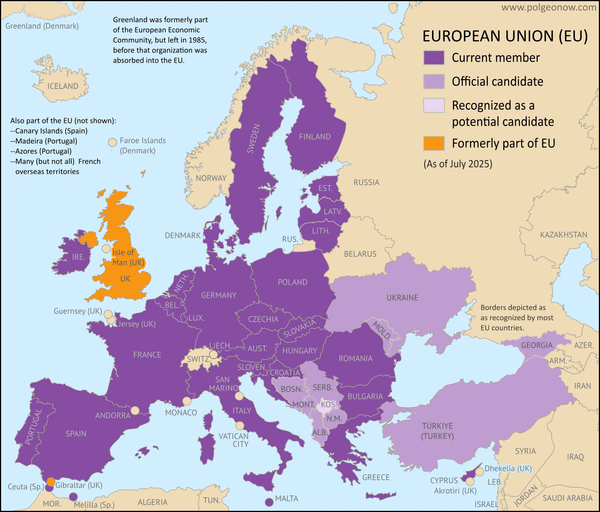
The thing which concerns me the most is that Trump might make his statements on Greenland come true. I hope domestic political and legitimate resistance will hinder him from this action.
That’s what came to mind today regarding these developments. What do you think? Have I missed something? Or have I completely misjudged anything? Sign up and write to me in the comments.
Picture source: https://people.com/donald-trump-shares-photo-nicolas-maduro-blindfolded-handcuffed-11878702
[1] X.com Beitrag von Pete Hegseth mit dem Tweet von Donald Trump:
https://twitter.com/PeteHegseth/status/2007382529830203465
[2] INTERIM REPORT UN Panel of Experts – Venezuelan Presidential Elections 28 July 2024:
https://digitallibrary.un.org/record/4062104?ln=en&v=pdf
[3] On human rights violations in Venezuela:
https://www.hrw.org/news/2025/04/30/venezuela-brutal-crackdown-elections
https://www.ohchr.org/en/hr-bodies/hrc/ffmv/index
[4] Responsibiliy to Protect (R2P):
https://www.globalr2p.org/what-is-r2p/#:~:text=The%20Responsibility%20to%20Protect%20(R2P)%20is%20an,assist%20individual%20states%20in%20meeting%20their%20responsibility.
[5] cfr - Fentanyl and the U.S. Opioid Epidemic:
https://www.cfr.org/backgrounder/fentanyl-and-us-opioid-epidemic
[6] Reuters - Trump says Venezuela's Maduro captured after strikes:
https://www.reuters.com/world/americas/loud-noises-heard-venezuela-capital-southern-area-without-electricity-2026-01-03/
[7] See on the oil topic:
https://intelligence.eklipx.io/article/3712
[8] BBC - Trump warns US will intervene if Iran kills protesters:
https://www.bbc.com/news/articles/c0q4z33pnnyo
[9] Monroe-Doktrin 3.0:
https://www.ebsco.com/research-starters/history/roosevelt-corollary
[10] What does it mean from a European perspective?
https://www.welt.de/politik/ausland/plus6958f588fb77630dac276333/venezuela-trump-schafft-fakten-und-verschiebt-die-weltordnung.html
[11] Ulrich Speck on LinkedIn: https://www.linkedin.com/posts/ulrich-speck-54a745a6_venezuela-my-quick-take-does-venezuela-activity-7413190673518219264-gcaj?utm_source=share&utm_medium=member_desktop&rcm=ACoAAA3DXzwBJWqaU9nqrBhdQ_pbNeCjx0xRbVQ