German security policy concerns
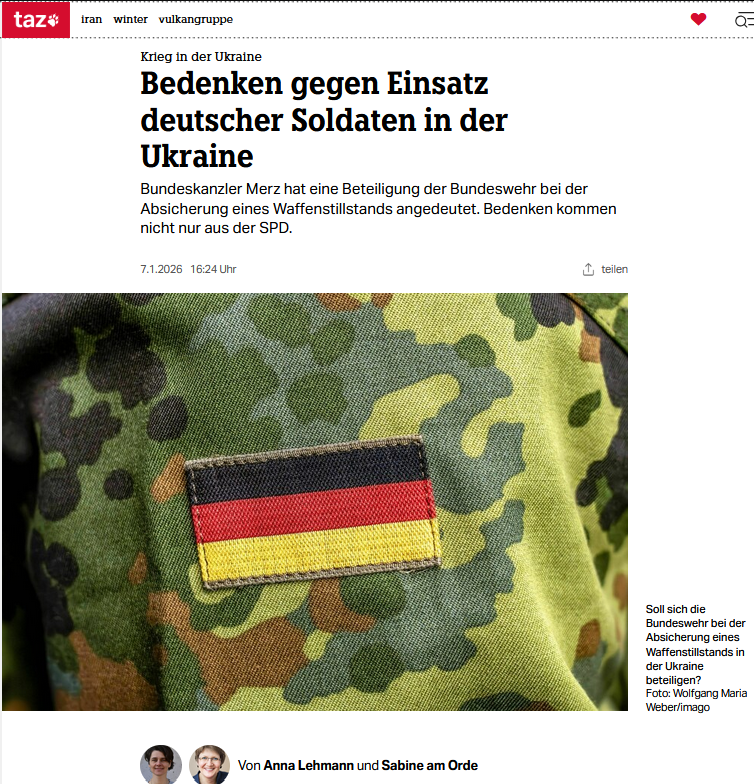
My understanding on the current debate to deploy German Armed Forces in Ukraine after a ceasefire agreement and the wider implications of German foot-dragging
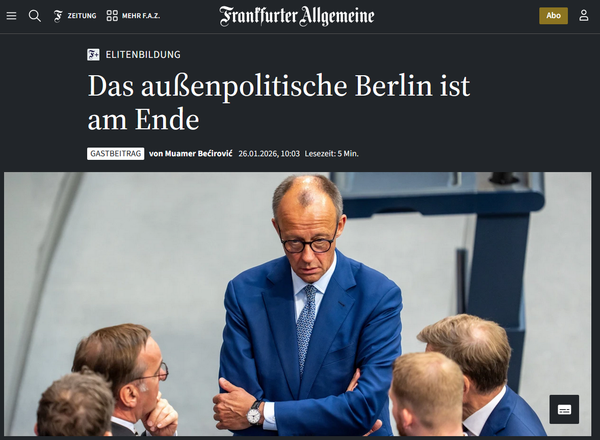
I fear that German politics still has a great deal to learn about deterrence. You cannot claim that you want to build the #Bundeswehr into the “strongest conventional army in Europe” [1] and then effectively rule out its deployment. Yet that is exactly what Chancellor Merz has done with his most recent statement.
While France and the United Kingdom are mentally and politically preparing for the deployment of soldiers to the #Ukraine in order to secure a ceasefire, Chancellor Merz once again distances himself. “German troops could primarily be deployed in ‘neighboring NATO states’ such as Poland or Romania. Directly in Ukraine? On that, only an evasive ‘we rule nothing out.’” That is not a strategy. That is a maneuver. Translated, it means: Germany wants to be part of the backdrop, but not part of the risk. Solidarity, yes—as long as it doesn’t hurt" [2]. And it is precisely this German dithering that prompts Trump to question the #NATO or to flirt with grabbing Greenland.
I understand the concerns, the political challenges, and the military risks associated with stationing troops in Ukraine. But such a restriction on the deployment of German forces sends unmistakable signals to Putin, Trump, Xi, and all European partners. The message is crystal clear: Germany is not prepared to lead and not prepared to take risks. And that is exactly what encourages Putin to hold out. And the problem is even bigger. It casts doubt on whether Germany would reliably stand by its allies in the event of an attack on NATO territory under Article V of the NATO Treaty.
The recent shelling of Lviv with Oreshnik IRBMs can and likely should be understood as a Russian warning that European troops could be targeted anywhere in Ukraine. Medvedev has expressed this very clearly [3]. But what would be the alternative? Allow Russia to do whatever it wants? That would be a slow death for Europe.
Deterrence, however, only works if the threatened measures are absolutely credible and also suitable to achieve the stated objectives.
Credibility “is composed of the following factors: the political will to act, clear communication about potential measures if the ‘red line’ is crossed, and actual military capabilities” [4]. At present, Germany is achieving NONE of this! Unfortunately, the rest of Europe is not doing much better either.
That said, Chancellor Merz’s position is partly understandable. Because it appears to be above all parts of the #SPD that—almost in classic Social Democratic tradition—are blocking any long-term and reliable commitment to Europe’s security and defense capabilities.
In taz, long-serving SPD member and former long-time member of the Bundestag Axel Schäfer from Bochum is quoted as saying: “German troops in Ukraine, where the Nazis committed horrific atrocities, would be almost as bad as German troops in Israel” [4]. This understanding of history and politics is deeply revealing. It seems preferable to wallow in supposed political-historical correctness and, in doing so, accept the destruction of Ukraine by Russia rather than do what is difficult, thankless, but necessary—namely, finally set Germany on a path where, after unimaginable historical crimes, it does the right thing: protecting Ukraine from renewed “horrific atrocities.” Moreover, it should be the task of the Ukrainian government to tell us Germans if our presence is not desired. This preemptive obedience, which ultimately only helps Putin, is unbearable.
“Sending German soldiers to Ukraine is something he, like many in the party, considers out of the question,” Schäfer told taz [5]. Whether this statement is actually tenable is beyond my knowledge. But the current political reality and the actions of the past nearly four years with regard to supporting Ukraine seem to confirm it. That Markus Söder makes a similarly empty demand and instead calls for the return of young Ukrainian men to Ukraine does not improve matters—especially since this is a straw man argument designed to distract from the real issue. Presumably because Söder himself is not yet willing to confront this difficult question.
The statements by SPD parliamentary group vice-chair Siemtje Möller and the SPD spokespersons for foreign affairs and defense, Adis Ahmetović and Falko Droßmann, are not much better. While all three emphasized that Germany must live up to its special responsibility, they added: “At the same time, it remains the case […] that first and foremost an agreement on a ceasefire is required.” The question of any kind of peace mission—however structured and composed—which would have to be mandated by the Bundestag, would only arise afterward. This short-sightedness is striking, but symptomatic of large parts of the SPD, of German politics in general, and of society as well. Yet it would be precisely the task of politics to put an end to this short-sightedness, lack of strategy, and dilettantism, and to provide the population with stronger leadership in security policy.
There are still one and a half months until the anniversary of the Russian attack on Ukraine. Progress in German defense policy does exist—no question about that. But measured against four years since the russian attack on Ukraine, Germany’s responsibility within Europe, constant demands from the U.S. to do more alone, and everything that is at stake, these advances are at best inadequate, and more likely simply insufficient.
[1] Government statement – Merz: German Armed Forces to become “the strongest conventional army in Europe”:
https://www.bundestag.de/dokumente/textarchiv/2025/kw20-de-regierungserklaerung-merz-1064956
[2] n-tv-article by Artur Weigandt:
https://www.n-tv.de/politik/Deutschlands-halbe-Solidaritaet-ist-Verrat-id30221185.html
[3] x.com post by Medvedev:
https://x.com/i/status/2009937833784488099
[4] DGAP Glossary "Abschreckung" (deterrence):
https://dgap.org/de/forschung/glossar/sicherheitsglossar/abschreckung
[5] taz article on the concerns of German politcians:
https://taz.de/Krieg-in-der-Ukraine/!6143503/