German & European impotence
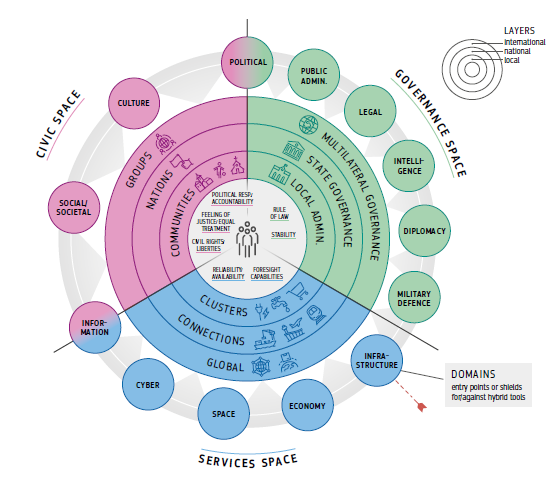
The title does not sound polite or positive and it is exactly meant this way
Why knowledge of power and hybrid threats is currently so important:
First, POWER:
ALL state action is based on power. This was recognized more than 2,500 years ago. Thucydides wrote in the now frequently cited Melian Dialogue [1]: “Just as you know, justice in human affairs only prevails where there is equality of power; the strong do what they can, and the weak suffer what they must.”
According to Max Weber, power means “every chance, within a social relationship, to assert one’s own will even against resistance, regardless of what this power is based on.” [2]
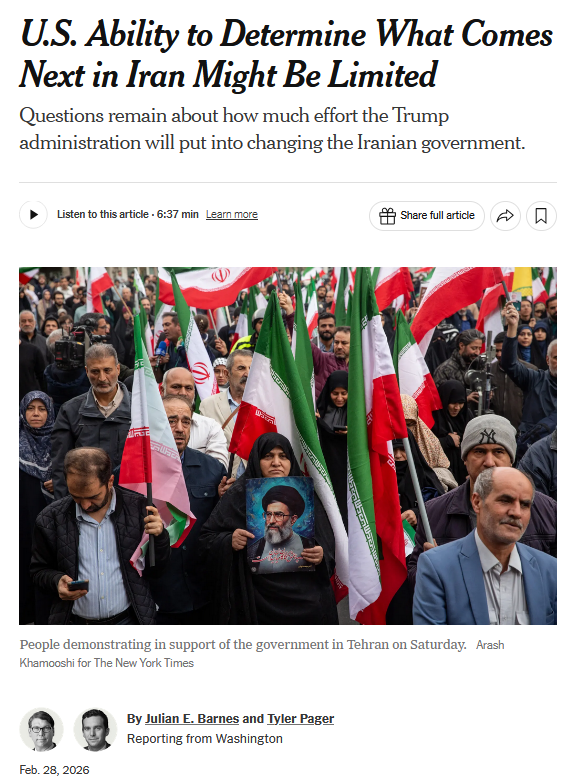
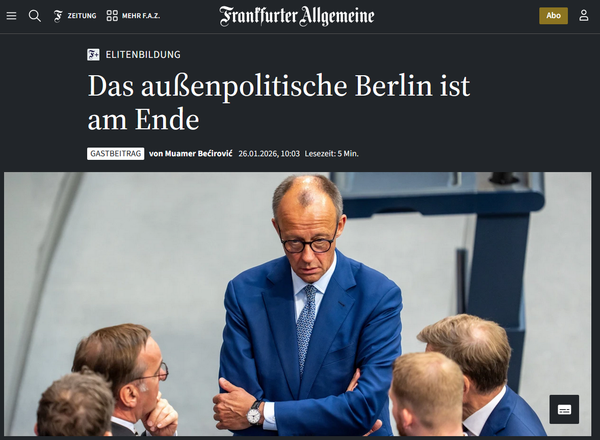
And this is precisely where the German and European problem lies. Since 1990, we have largely outsourced the enforcement of our power to the United States. That worked well for 30 years because interests were similar. We were politically and mentally unprepared for this extreme divergence of interests, even though the signs had been apparent long before. And now we are realizing that the foundation of all power—regardless of what individual opinions may wish it to be—is ultimately the ability to project hard power, i.e., military power. But we did not only outsourced our military power to the U.S., but we outsourced the foundation of our economic wealth to China. We outsourced production, we outsourced intellectual property and knowhow. All these developments had two severe consequence: we bought dependencies we are not able to control or influence and we spend the money we saved or the fortune we made either in a social welfare system we cannot afford for the forseeable future and we gave the economic earnings to shareholders. We made the rich even richer. We did in both ways not invest in our future and the future of our children.
Second, HYBRID THREATS:
If one looks at current studies on hybrid threats [3] [4], it becomes clear which domains the above-mentioned power projection and enforcement operate in. There are thirteen. Reading these documents also reveals which tools can be used to enforce power below the threshold of armed violence—40 categories.
And this is precisely what defines the age of polycrises. It must be borne in mind that polycrises do not simply mean that many (poly) crises follow one another, but rather that many crises occur simultaneously, overlap in time and substance, are interdependent, and therefore have mutually reinforcing effects as well as second- and third-order effects.
To some, this may sound cynical, but I see no other solution.
And what does this mean now...
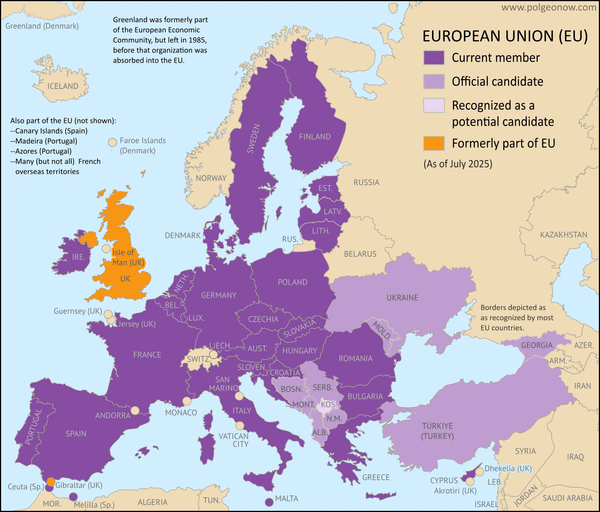
...in the various debates on countering Russian hybrid threats, countering China’s economic warfare, possible U.S. influence on Europe—be it through the “influence of patriotic European parties” [5]—or threats to the sovereignty of Greenland?
Germany and Europe must develop measures across all thirteen domains to counter the relevant 40 tools in order to protect themselves effectively. Beyond that, we must expand our power in all 13 domains—not only defense, or the economy, or diplomacy—to the point where we can assert our interests against resistance. Since we cannot permanently protect ourselves against everything, nor will we always be able to assert our interests, we must also significantly increase our resilience—in all 13 domains, across domains, and across society as a whole. This also includes becoming aware of critical dependencies, particularly in the areas of energy and technology, and diversifying these critical dependencies as broadly as possible in order to avoid accumulation risks.
And for all apologists of international law and diplomacy: international law and diplomacy can only be effective if, in the background, there are additional instruments of power projection—especially hard power, meaning military and also economic power—that can overcome resistance.
This way of thinking and acting may still seem alien or even objectionable to many at present. But if you cannot clearly name other functioning alternatives, you must come to terms with what has worked for more than 2,500 years. One might have hoped that civilizational progress over the last two and a half millennia would have been greater, but hope, unfortunately, does not determine reality.
Once again, this is not about the United States alone, but about Germany and Europe in the world as it is, not the world some wish it to be. At present, Russia and, above all, China play a role in this. But Iran and other countries will follow this example as well. Within Europe, Hungary and Serbia repeatedly challenge us. Relations with Turkey are also not always easy. Through these countries, we are increasingly challenged internally as well—in Germany and all other European countries—by hybrid threats. This is not a new phenomenon. But due to digitalization, connectivity, automation, and globalization, these hybrid threats have an unprecedented impact on every single one of us in almost all areas of life.
Second, this is not about individual policy areas or domains of political action, but about the ability to achieve sovereignty in all domains, to make decisions, and to enforce them (POWER).
And for all those for whom this is still not enough of a problem—the issue of climate change and its consequences has not even been taken into account here. Yet these will become enormous in the coming decades and will add to all of this.
I wish we would accept this reality quickly and act accordingly. There have been more than enough warnings for over two decades.
What do you think? What are our greatest challenges? And what prevents us from recognizing reality?
[1] Thukydides: Der Peleponesische Krieg, 2000, 452, V. Buch, §89.
[2] Hans J. Morgenthau: Macht und Frieden. Grundlegung einer Theorie der internationalen Politik, 1963, S. 26.
[3] Hybrid CoE: Threat Landscape, p. 5. These domains are: Diplomacy, Political, Culture, Social/Societal,Legal, Military/Defence, Space, Administration, Infrastructure, Economy,Intelligence, Information, Cyber.p 27.
[4] Jungwirth,R., Smith H., Willkomm E., Savolainen J., Alonso Villota M., Lebrun M., Aho A.,Giannopulos G., Hybrid threats: a comprehensive resilience ecosysystem,Luxembourg 2023, p. 9.
[5] U.S. National Security Studies 2025, p. 26. https://www.whitehouse.gov/wp-content/uploads/2025/12/2025-National-Security-Strategy.pdf