Clausewitz, hybrid threats and Germany's OPLAN
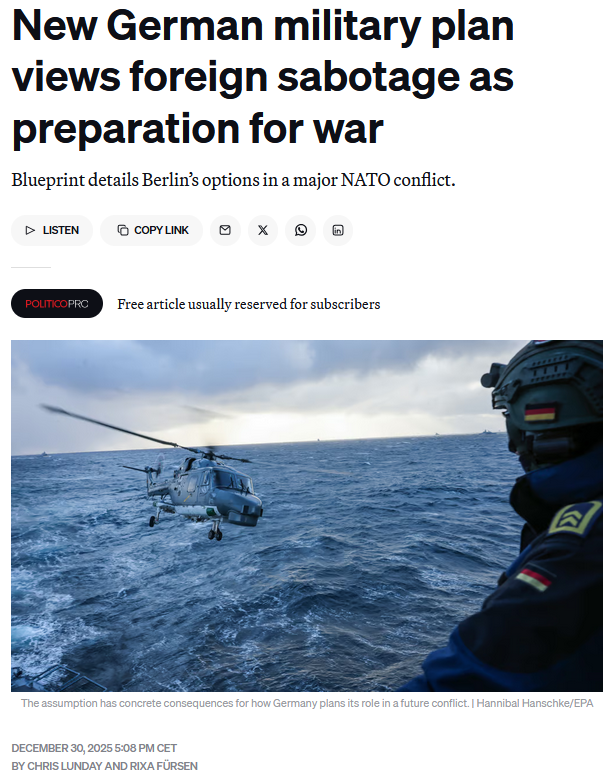
Apparently, a lower-classified version of Germany’s Operations Plan (OPLAN DEU) has now been released by the Ministry of Defence [1]. The full plan is apparently classified as 'Secret'. This created the problem, however, that most authorities, institutions, and organizations that are required to work with the OPLAN were unable to access or use it due to a lack of security clearances.
However, I am somewhat surprised by the astonishment of the author of the Politico article when he writes: “The document states that hybrid measures ‘can fundamentally serve to prepare a military confrontation.’ Rather than treating cyber operations or influence campaigns as background pressure, the plan places them directly within the logic of military escalation.”
What exactly is supposed to happen in a defence scenario? Are espionage, sabotage, and subversion suddenly supposed to stop?
Hybrid threats are particularly attractive for states such as Russia or China in the current situation because these measures do not trigger a military confrontation. They are deliberately actions below the threshold of armed force [2], yet they are so massive and extensive that they allow the two states mentioned to terrorize—or wage wars in—the entire South China Sea or Eastern Europe either with impunity or with only very mild punishment (sanctions, embargoes). In this way, hybrid threats at least partially fulfill what Clausewitz already identified as the objective of wars: “to render the enemy defenseless” in order “to impose our will upon him” (page 3) [4]. However, as could be clearly seen in the example of Ukraine, these 'soft power' measures of hybrid threats do not lead to the final objective. At a certain point in the confrontation, war—as “a mere continuation of policy by other means” (page 15)—must therefore be introduced in order to decide this “struggle.”
Because hybrid measures have already proven to be highly efficient and effective in the pre-war phase, it makes no sense to abandon them during the actual war. In a defence scenario, they no longer serve the general weakening of societal or democratic institutions or processes, but rather the support of war objectives.
While in the pre-war phase nearly all targets that generally weaken the opponent and their societal cohesion [5] can be attacked, during war the focus will presumably shift more toward defence-critical infrastructure—or, as can currently be observed in #Ukraine, toward targets that increase civilian suffering and thereby weaken morale (energy supply and heating during winter).
Incidentally, NATO already explicitly agreed in 2016 that hybrid threats can also trigger Article V [3].
The question of when war will break out does not, of course, depend on the effectiveness of hybrid threats. A multitude of factors play a role here: developments in armament policy, alliance policy, domestic policy, and the economy. However, hybrid threats can negatively accelerate or, if necessary, steer these developments.
What do you think will change with regards to hybrid threats when the overall situation changes from a tense peace to a full war?
[1] Politico - New German military plan views foreign sabotage as preparation for war:
https://www.politico.eu/article/germany-new-military-plan-foreign-sabotage-hybrid-attacks-as-preparation-for-war/
[2] A defintion on hybrid threats can be found here:
https://www.consilium.europa.eu/en/policies/hybrid-threats/#what
[3] NATO - Hybrid threats & Article V NATO Treaty:
https://www.nato.int/en/what-we-do/deterrence-and-defence/countering-hybrid-threats
[4] Clausewitz - Vom Kriege:
https://www.clausewitz-gesellschaft.de/wp-content/uploads/2014/12/VomKriege-a4.pdf
[5] DGAP paper on national cohesion:
https://dgap.org/en/research/publications/national-cohesion
Source of the title picture: [1]